
photo credits to owner
You walk into a room with your shirt on backwards. You realize it halfway through the meeting. Panic. Everyone must’ve noticed, right? You can already feel the judgment. But here’s the kicker—they probably didn’t even care.
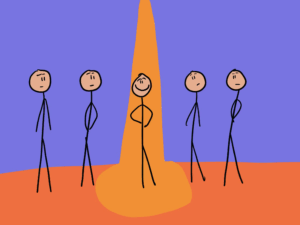
This is the spotlight effect in action: our tendency to overestimate how much attention others are paying to us. It’s not narcissism—it’s just psychology. Since we’re the center of our own experiences, we assume we must be the center of others’. But the truth? Most people are too busy worrying about themselves to think twice about your wardrobe malfunction.
The term “spotlight effect” was coined by psychologists Thomas Gilovich, Victoria Medvec, and Kenneth Savitsky in 2000. In one of their studies, they asked participants to wear a cringey Barry Manilow T-shirt into a room of strangers. The wearers guessed that nearly half the people would notice. In reality, fewer than a quarter did. That’s not just humbling—it’s freeing.
This cognitive bias shows up everywhere:
You post something online and obsess over how it’s received.
You flub a word in a conversation and replay it in your mind all day.
You show up to an event slightly underdressed and feel like a flashing neon sign.
But here’s the truth bomb: most people are caught in their own spotlight effect, worrying about how they are being perceived. Your embarrassing moment is just a flicker in someone else’s peripheral vision.
This phenomenon is closely related to egocentrism—not in a self-centered way, but in a neurological one. We interpret the world through our own lens. It takes effort to step outside ourselves and consider how others truly see us. And we’re usually wrong.
But here’s where it gets interesting: the spotlight effect isn’t just a psychological trap—it’s a potential superpower. Once you recognize it, you can start to use it. Imagine taking a risk, speaking up, dancing like a goof at a wedding, or trying something new—all without the fear of judgment. Because now you know: most people aren’t watching, and if they are, they probably won’t remember in five minutes.
This also has profound implications for mental health. People with social anxiety often fall victim to the spotlight effect, assuming every glance is a judgment, every silence is rejection. Realizing that most of this pressure is self-imposed can be a powerful relief.
Want to reduce the spotlight effect in your life? There are several things you could try:
Flip the perspective: Ask yourself, “Would I notice this if someone else did it?”
Practice empathy: Everyone else is just as self-conscious as you.
Zoom out: In the grand scheme of things, will this moment matter tomorrow? Next week? Probably not.
So the next time you find yourself spiraling about that awkward handshake, weird comment, or spinach in your teeth—breathe. You’re likely the only one who noticed. What bold move have you been holding back?
Written by:
Shriya Anandakrishnan
Leave A Comment